Monday, May 1, 2023

Five Benefits of Talking About Your Mental Health with Peers

Five Benefits of Talking About Your Mental Health with Peers

Talking about mental health with peers is one of the best ways to celebrate mental health awareness month. The more that we talk about mental health, the more normalized these conversations become. It inspires hope as the stigmas associated with mental health begin to dissipate, especially as you share your own experiences with mental health and listen to others talk about their mental health.
Five Benefits of Talking About Your Mental Health with Peers

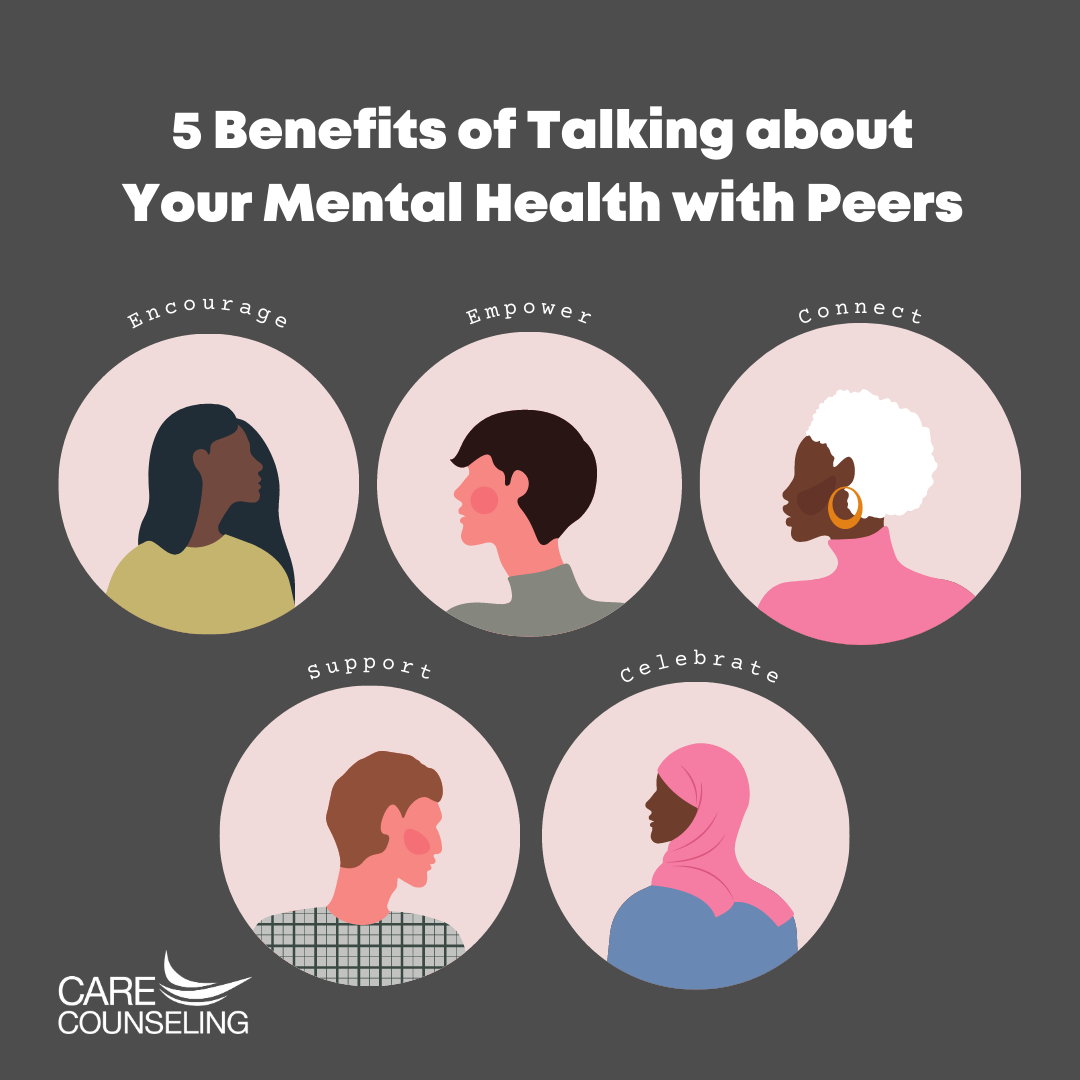
Here are Five Benefits of Talking About Your Mental Health with Peers

Encourage

Talking about your experiences, especially what has been helpful for your mental health encourages others to also talk about their experiences. Peers can be a great source of encouragement.

Empower

Talking about your mental health can empower others to embrace aspects of themselves and take positive steps such as making the decision to see a therapist for the first time. Talking about topics that may have previously been avoided due to stigma can empower you to find your voice and overcome shame.

Connect

Talking about mental health can help make new friends and connect to others who share similarities such as current stage of life, presenting concerns, or mental health diagnosis. Talking about mental health can also help you feel more connected to a larger community.

Support

Talking about mental health can greatly support others, both 1:1 and in settings such as mental health support groups.

Celebrate

Talking about the ‘wins’ that are part of your mental health journey such as making progress towards goals and becoming a stronger version of yourself is something to celebrate and talk about. Acknowledging wherever you are currently, embracing imperfections, and celebrating yourself and the journey is important.

Written By: Charlotte Johnson, MA, LPCC


We’re Here to help


Our wellness experts will be happy to take care of you. You can CLICK HERE to schedule an appointment now or call (612)223-8898.


Meet Clinicians


We’re united by our commitment to providing effective, relevant, and innovative mental health support at all stages of your journey. Click Here to find a therapist or find out more about who we are, where we come from, and how we live out CARE’s mission every day.


The professionals at CARE are actively collecting and creating resources to help with what you need and address frequently asked questions. We’re Here for You.


source https://care-clinics.com/five-benefits-of-talking-about-your-mental-health-with-peers/

Thursday, April 27, 2023

Three Strategies for Coping with Overwhelming Problems

Three Strategies for Coping with Overwhelming Problems

Coping with Overwhelming ProblemsProblems are not something that we often want to deal with. They tend to bother us at the most inconvenient times while shouting “do something”. One of the difficulties is that the answer to solving a problem is not always quite so clear. Problems can be complex and complicated. There may be uncertainty about the outcome, especially in major recurring problems such as ones that occur in relationships, or in settings that you cannot avoid such as work, school, or home. The feelings that problems bring can be overwhelming—exasperation, worry, fear, sadness, anger, and frustration to name a few.
I’d like to share three strategies for coping with overwhelming problems which include skills for solving problems, regulating emotions, and managing distress.

  1. Use Problem-Solving Skills

This strategy involves first defining the problem. Then identify and explore possible solutions, pick one to try, and reflect on the outcome. This may seem like a fairly straightforward process (for simple problems) but people are complex and so are many of the decisions. Another factor is that there are often too many choices. From everyday decisions such as picking out a box of cereal at the grocery store, to major purchases such as a new vehicle or home. When it comes to making decisions that impact your future self, there are a lot of factors to consider. Problem-solving therapy can help provide tools to assist with the problem-solving process.

  1. Use Emotional Regulation Skills.

While this is not a solution to solving the problem, emotion regulation skills can help create some space to pause between your feeling and reaction. By doing so, you are regulating your response to the problem to one with more emotional control. This also helps by creating space to reflect on the things that you want, love, and value.

Some activities that a therapist can help with include identifying emotions that come up in recurring problems, noticing, and naming feelings and sensations in the body and any thoughts associated. They can then assist with specific tools to help regulate the emotion and support you with strategies that help allow greater acceptance and adaptability while reminding you to show some compassion towards yourself in a moment of suffering.

  1. Use Distress Tolerance Skills.

If you are feeling overwhelmed by problems, it is going to be very difficult to think clearly in a heightened emotional state. Distress tolerance skills help manage distress to problems that feel out of control such as in a state of crisis. Think about difficult situations in your life that might create a lot of distress- losing your job or a relationship, being diagnosed with a life-threatening medical condition, experiencing physical or sexual assault, losing a loved one due to suicide, etc. Taking care of yourself by using sensory soothing and distraction can help get through this time, before facing all the problems and decisions that come next.

  1. Do Nothing (Not Recommended)

There is always the option to do none of the above—to not deal with problems. Maybe you lack the self-awareness to know that a problem exists. Perhaps you put on a fake smile and tell yourself that everything is “fine” and hope that things will change while you clearly know that there is a problem but are too scared to do anything. The fear (such as vulnerability, possible failure, loss, or rejection) can seem too great for the risk, and you’d rather remain in an unhappy situation and silently suffer.  Doing something requires work and maybe you don’t want to put in the effort. You likely don’t have a plan or resources to help support you. This sounds depressing and hopeless!

If you are tired of feeling stuck in a problematic situation, then I encourage you to do something. CARE Counseling has same week-availability for therapy appointments to help you act. Working together, we can gain clarity on problems, develop a treatment plan, process stressors, and learn new skills to cope.

Written By: Charlotte Johnson, MA, LPCC


We’re Here to help


Our wellness experts will be happy to take care of you. You can CLICK HERE to schedule an appointment now or call (612)223-8898.


Meet Clinicians


We’re united by our commitment to providing effective, relevant, and innovative mental health support at all stages of your journey. Click Here to find a therapist or find out more about who we are, where we come from, and how we live out CARE’s mission every day.


The professionals at CARE are actively collecting and creating resources to help with what you need and address frequently asked questions. We’re Here for You.


source https://care-clinics.com/three-strategies-for-coping-with-overwhelming-problems/

Help, My Life Feels Empty!

Help, My Life Feels Empty!

  • Help! My Life Feels Empty!Does your life feel like it is dull, and boring, with nothing to look forward to?

  • Do you lack interest and motivation to do anything?
  • Does it feel like things are hopeless, that they will never change?
  • Do you struggle to see your value and worth, and question if life is worth living?
  • Do you feel alone–lonely and disconnected?
  • Is it hard to experience a range of emotions and all you feel is emotional numbness?

*Note: If you are experiencing thoughts of suicide or mental health crisis, call 988 or your local crisis resource numbers.

Biopsychosocial factors such as genetic predisposition to mental illness, experiences of stressors and trauma, social, and environmental factors can all contribute to feelings of emptiness. For some people, these thoughts and feelings are in response to an event that changes them. For example, perhaps you can recall a time in which you experienced interest and pleasure but then an event happened that sucked out all the joy and life inside of you.

I want to take a moment to acknowledge that many people have experienced some awful events, especially within the context of relationships. It pains me to think of all the children who experience neglect, abuse, and other adverse childhood experiences (ACES). For adults who have experienced complex trauma in childhood and are continuing to be impacted in adulthood, it can take time to feel integrated and whole when parts of oneself have been disconnected. This includes part of the physical body, one’s mental state, and the spiritual aspects of self.

Feelings of emptiness may be present in various mental health conditions. While feeling empty is something most people are likely to experience at times, this is different than when feelings are present for periods of time and associated with other symptoms. For example, loss of interest and pleasure, feelings of hopelessness, and low self-worth are common in depression. Chronic feelings of emptiness and emotional detachment, known as depersonalization are symptomatic of borderline personality disorder. Descriptions of chronic emptiness in patients with borderline personality disorder include the following: “feeling dead inside”, “void”, “feeling swallowed”, “like a shadow”, and “social alienation”. Similar symptoms are also characteristic of trauma disorders such as post-traumatic stress disorder.

There are many interventions that come to mind that can be helpful, depending on the unique experiences of each person. If you would like to talk to a trained mental health specialist about therapy options, CARE Counseling has in-person and telehealth options with a wide variety of therapists: https://care-clinics.com.

Here are some things to consider in terms of opposites and possible needs:

  • If you feel life is dull and boring, perhaps what you need is something interesting and exciting to look forward to.
  • If you lack interest and motivation, perhaps what you need is to treat any underlying mental health conditions, create healthy routines to help renew energy, and seek support with an accountability partner.
  • If you feel like things are hopeless, perhaps what you need is some hope that things will get better. This will become more real as you start seeing changes in your life while reframing unhelpful thought patterns.
  • If you struggle to see your own self-value and worth, I want to let you know that you are precious. You matter and your life matters. Let’s talk about this.
  • If you are feeling alone and lonely, then you likely need to feel that you are loved and have support. Seeking connection and companionship where you can talk, listen, build relationships, and be part of a community can help.

If you struggle to experience emotions, then what you may need is some therapeutic support to work with emotions, parts of yourself, and the experiences which have contributed to numbness. Rather than feeling like a shadow, you can start to see and experience yourself, becoming stronger, more vibrant, and fully alive.

Written By: Charlotte Johnson, MA, LPCC


We’re Here to help


Our wellness experts will be happy to take care of you. You can CLICK HERE to schedule an appointment now or call (612)223-8898.


Meet Clinicians


We’re united by our commitment to providing effective, relevant, and innovative mental health support at all stages of your journey. Click Here to find a therapist or find out more about who we are, where we come from, and how we live out CARE’s mission every day.


The professionals at CARE are actively collecting and creating resources to help with what you need and address frequently asked questions. We’re Here for You.


source https://care-clinics.com/help-my-life-feels-empty/

Thursday, April 13, 2023

JOHN HUTCHINSON SELECTED AS 2023 HEALTH CARE HEROES HONOREE BY MINNEAPOLIS/ST. PAUL BUSINESS JOURNAL

JOHN HUTCHINSON SELECTED AS 2023 HEALTH CARE HEROES HONOREE BY MINNEAPOLIS/ST. PAUL BUSINESS JOURNAL.

John Hutchinson, Healthcare Hero 2023John Hutchinson, COO and President of CARE Counseling was announced as one of the 2023 Health Care Heroes honorees by Minneapolis St. Paul Business Journal. To view the announcement, visit https://bizj.us/1qi8j9
The Minneapolis/St. Paul Business Journal launched our Health Care Heroes awards in 2021 to recognize individuals in the Twin Cities for putting innovation, care, dedication, and compassion to work to improve the human condition.

Those in health care fields continue to go above and beyond in their daily lives and given the quality and quantity of nominations for our third annual Health Care Heroes awards, the selection process was difficult for our judges. This year’s honorees include doctors, nurses, social workers, administrators, entrepreneurs and more.

About Minneapolis/St. Paul Business Journal

The Minneapolis/St. Paul Business Journal is a multi-platform media company providing in-depth coverage of local business communities and breaking news reaching thousands of readers each week. Through print, digital products such as its twice-a-day emailed news digests and face-to-face events, the Business Journal offers business leaders many avenues for making connections and gives them a competitive edge locally, regionally and nationally. Visit us at mspbj.com to learn more.


We’re Here to help


Our wellness experts will be happy to take care of you. You can CLICK HERE to schedule an appointment now or call (612)223-8898.


Meet Clinicians


We’re united by our commitment to providing effective, relevant, and innovative mental health support at all stages of your journey. Click Here to find a therapist or find out more about who we are, where we come from, and how we live out CARE’s mission every day.


The professionals at CARE are actively collecting and creating resources to help with what you need and address frequently asked questions. We’re Here for You.


source https://care-clinics.com/john-hutchinson-selected-as-2023-health-care-heroes-honoree-by-minneapolis-st-paul-business-journal/

Monday, April 10, 2023

Autism, Anxiety, and ADHD Overlap: 5 Strategies to Address a Trio+ of Concerns

Autism, Anxiety, and ADHD Overlap: 5 Strategies to Address a Trio+ of Concerns

Autism, Anxiety, & ADHDApproximately 50-70% of persons with autism spectrum disorders (ASD) also have attention-deficit hyperactivity disorder (ADHD) according to the scientific literature meta-analyses. In addition, up to 84% of people with autism have some form of anxiety and as much as 17% specifically may have OCD obsessive-compulsive disorder.

As a mental health specialist who works with children, teens, and adults with autism, anxiety, and ADHD I have also noticed significant overall. During my involvement with a group of parents seeking support for their children with autism, one thing that I found fascinating is that EVERY parent in the room had a child who also was diagnosed with ADHD and an anxiety disorder such as generalized anxiety, social anxiety, or obsessive-compulsive disorder. This was a “common trio” in addition to other concerns that were unique to each family such as specific developmental delays and behavioral or learning challenges.

Children with autism and ADHD often have additional mental health conditions such as anxiety, depression, behavioral problems, developmental delay or intellectual impairment, speech, or language disorders, and/or learning disabilities. These overlaps can complicate the diagnostic process depending on the scope of practice of the specialist seen. For example, comprehensive testing may be recommended after an initial diagnostic evaluation for mental health and behavioral difficulties to specifically confirm a diagnosis such as Autism and ADHD. Since these are neurodevelopmental, it is important to have data from multiple settings and specific diagnostic tools including ones that focus on attention, memory, learning, and social communication to help inform diagnosis and recommendations.

Researchers have found that autism and ADHD both have significant symptom overlaps. One of the findings is that there were increased difficulties with behavioral self-regulation for children with both autism and ADHD than for children with a primary diagnosis of autism or ADHD alone. While studies have found that children with ASD and ADHD have different behavioral and neuro-cognitive profiles, there are some similarities. For example, children with ADHD commonly struggle with behavioral self-regulation, impulsivity, and hyperactivity as primary diagnostic features. For children with autism, behaviors are related to social communication and “quirky” or “odd” behavior but also display self-regulation difficulties. Also, both groups struggle with executive functioning such as planning and attention, which have some variation in how these present.

Since there is an overlap of some of the symptoms of autism, anxiety, and ADHD, it can be challenging to know where to start and what to address. Many times, this includes a multi-disciplinary team of professionals who can help meet the unique needs and impairment levels at various stages of development from childhood to adulthood.

Here are 5 strategies that can be a starting point for diagnosis and treatment interventions:

  1. Talk to your pediatrician or primary care doctor about your concerns. Screening and early intervention are so important, and a medical diagnosis can help with support in other settings such as school. Your doctor can assist with referral options for other specialists.
  2. Talk to your school social worker or counselor about services and supports available through the school. This includes exploring eligibility for evaluation as part of an individualized education plan (IEP). The evaluation process often includes testing in areas such as a child’s overall cognitive ability, performance in academic areas, speech-language, motor developmental, and emotional/behavioral concerns. Another option is to seek outside evaluation for children who receive services in a non-public school setting.
  3. Talk to a mental health specialist about therapy options. A generalist therapist such as the providers at CARE Counseling can assist with therapeutic strategies to help with emotional and behavioral symptoms and can offer resource and referral options if additional comprehensive testing is needed to clarify a neurodevelopmental diagnosis.
  4. Connect with other parents/ caregivers, and individuals for support. This can be a helpful environment to learn from each other, share challenges and successes, connect to resources, and find a sense of community.
  5. Focus on strategies that can be helpful for multiple diagnoses. Examples include improving behavioral self-regulation, improving social communication skills, increasing tolerance of uncertainty, and developing routines that balance planning ahead, time management, flexibility, and behavioral management.

Written By: Charlotte Johnson, MA, LPCC


We’re Here to help


Our wellness experts will be happy to take care of you. You can CLICK HERE to schedule an appointment now or call (612)223-8898.


Meet Clinicians


We’re united by our commitment to providing effective, relevant, and innovative mental health support at all stages of your journey. Click Here to find a therapist or find out more about who we are, where we come from, and how we live out CARE’s mission every day.


The professionals at CARE are actively collecting and creating resources to help with what you need and address frequently asked questions. We’re Here for You.


source https://care-clinics.com/autism-anxiety-and-adhd-overlap-5-strategies-to-address-a-trio-of-concerns/